
The NDIS Worker Screening Check is a national background assessment required to work in risk-assessed roles with NDIS-registered providers. It is not the same as a police check, and it is not optional for most disability support roles.
Most registered NDIS providers expect two things from new workers before placing them with participants: this check, and a relevant qualification. The check confirms you are safe to work with people with disability. The Certificate III in Individual Support confirms you are trained to do the job. Both take time to obtain — and the good news is that the two to twelve week processing period for your check is the ideal window to get your qualification underway. Compare courses on Coursely while you read →
This page covers everything you need to know about the check itself — what it is, who needs one, what it costs in your state, and how to apply.
What is the NDIS Worker Screening Check?
The NDIS Worker Screening Check is a suitability assessment — it determines whether a person poses an unacceptable risk to people with disability. It was introduced on 1 February 2021 to replace a fragmented patchwork of state-based systems.
The check is administered by State and Territory Worker Screening Units (WSUs) and overseen nationally by the NDIS Quality and Safeguards Commission. Once cleared, a worker's status is recorded in the national NDIS Worker Screening Database (NWSD), which is accessible to employers and portable across all states and territories for five years.
Who needs one?
Registered NDIS providers are legally required to ensure that anyone in a risk-assessed role holds a valid clearance before commencing work. Risk-assessed roles include:
- Direct service delivery — any role involving the direct delivery of NDIS supports to participants
- Key personnel — directors, CEOs, and senior board members of registered providers
- More than incidental contact — roles involving physical contact with participants, building rapport, or unsupervised access to participant information
This is broader than many people expect. Administrative and maintenance staff working in settings where they have regular access to participants or their data may also be captured.
Workers employed by self-managed participants or unregistered NDIS providers are not legally required to hold a clearance, though many employers in this segment still prefer it.
A note on qualifications: The screening check addresses your suitability. Your qualification addresses your capability. Most registered NDIS providers want both — and the Certificate III in Individual Support is the standard entry-level qualification for disability and aged care support work. If you haven't looked at your qualification options yet, Coursely compares courses from 40+ providers side by side — fees, funding, delivery modes, and durations — free to use, no phone number required. If you are weighing study modes, our guide to online vs on-campus Certificate III in Individual Support summarises the trade-offs.
NDIS Worker Screening Check vs National Police Check
A National Police Check does not satisfy the legal requirement for risk-assessed roles. The two checks serve different purposes and should not be treated as interchangeable.
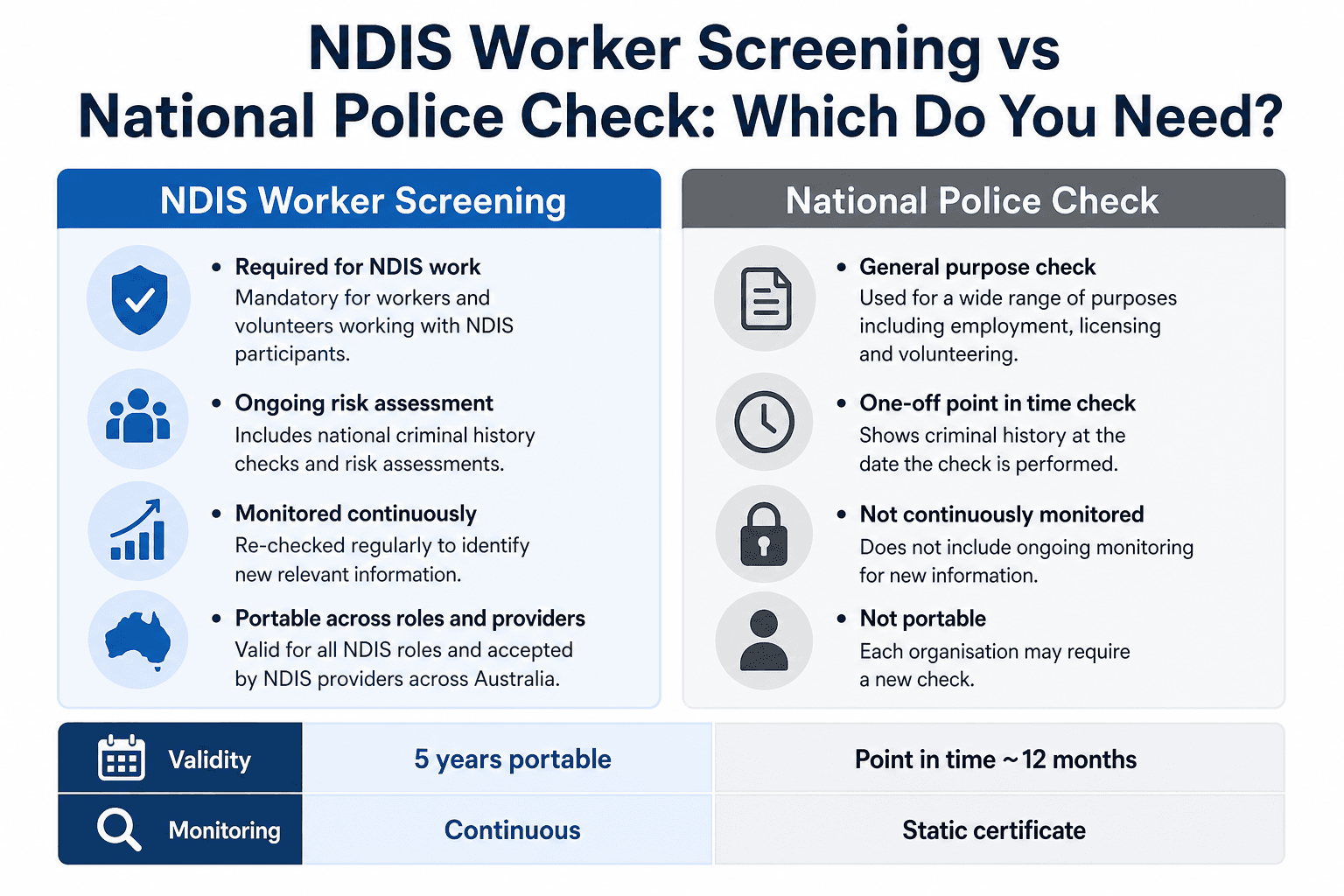
| Feature | NDIS Worker Screening Check | National Police Check |
|---|---|---|
| Purpose | Sector-specific suitability assessment | General criminal history disclosure |
| Validity | 5 years, nationally portable | Point-in-time (typically 12 months) |
| Monitoring | Continuous — re-checked automatically for new charges or changes | Static — requires a new application for updates |
| Legal status | Mandatory for risk-assessed roles with registered providers | Insufficient for risk-assessed roles |
| Decision outcome | Clearance or Exclusion issued by WSU | Certificate listing history only — no decision made |
The continuous monitoring element is significant. The NWSD automatically re-checks worker status on a regular basis and alerts employers to any change — such as a suspension or interim bar — in real time. Employers are required to remove workers from risk-assessed roles immediately upon receiving such a notification.
How much does it cost?
Fees are set by each state and territory and are subject to annual indexation. The table below reflects the 2025–2026 fees based on official Worker Screening Unit data. Volunteer applications are free in most jurisdictions.
| State/Territory | Authority | Paid Worker Fee | Volunteer Fee | Apply |
|---|---|---|---|---|
| NSW | Service NSW | $107.00 | Free | service.nsw.gov.au |
| VIC | Service Victoria | $135.50 | Free | service.vic.gov.au/ndis |
| QLD | QLD Government WSU | $156.00 | Free | workerscreening.qld.gov.au |
| WA | Department of Communities | $145.00 ($80.00 concession) | $11.00 | wa.gov.au/communities |
| SA | DHS Screening Unit | $117.00 | Free | screening.sa.gov.au |
| TAS | CBOS / Justice | $133.70 | Free | justice.tas.gov.au/rwvp |
| ACT | Access Canberra | $195.00 | Free | accesscanberra.act.gov.au |
| NT | SAFE NT | $145.00 | $14.00 | pfes.nt.gov.au/safent |
Note on ACT: The higher fee reflects that the ACT integrates NDIS screening with a broader Working with Vulnerable People (WWVP) registration, covering multiple sectors simultaneously.
Note on Tasmania: From 1 January 2026, Tasmania offers two-year fee relief for the volunteer-only class. The $133.70 fee applies to the paid worker class.
How to apply — the five steps
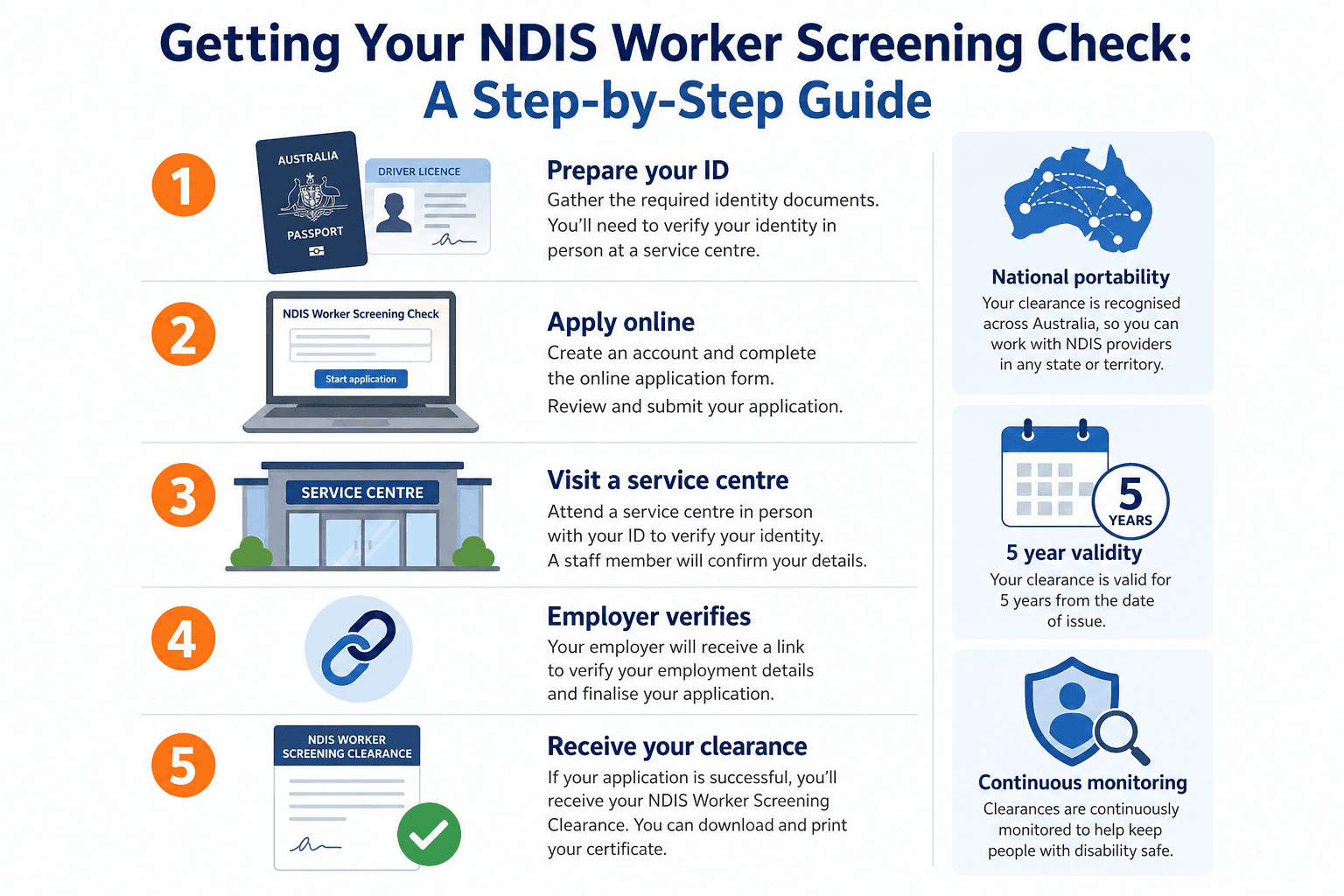
- Gather 100 points of identity. Collect original documents across Categories A, B, and C — see the identity section below for details.
- Start your online application. Log in to your state or territory portal, enter your personal history, five years of address and employment history, and your NDIS employer's ID. Your employer will provide this to you — it is their registered identifier in the NWSD.
- Visit a service centre (NSW and Tasmania only). Present original identity documents and have your digital photo taken within 28 days of your online submission.
- Employer verification. Your nominated employer must log in to the NWSD and verify your employment link. This must happen within 30 days of your submission — if they miss this window, your application may be cancelled and you may forfeit your application fee. Follow up promptly.
- Receive your clearance. Once assessed, your digital record is updated in the national database. Your clearance is valid for five years and subject to continuous monitoring throughout that period.
What if you don't have an employer yet?
In most states and territories, your application requires you to nominate an NDIS employer and link your application to them through the NWSD. Without an employer code, you generally cannot complete your application — which creates a catch-22 for workers who are job-ready but haven't secured a role yet.
One practical way around this is to register with HireUp, an NDIS-registered platform that connects support workers with participants. HireUp accepts new worker registrations and, once you are signed up, can provide you with their employer code. You can use this code to lodge your NDIS Worker Screening Check application immediately — before you've found a long-term employer or been placed with a participant.
This means you can get your application clock ticking during your course or job search, rather than waiting until after you've accepted a role. Once you secure a permanent position with another provider, your clearance simply transfers — it is nationally portable and linked to you, not to any single employer.
Note: Registering with HireUp to access their employer code does carry an expectation that you are genuinely open to working on their platform. It is not a workaround to game the process — but if you are open to shift-based support work while getting established in the sector, it is a legitimate and commonly used path.
Identity documents you will need
You will need original documents (not photos or scans) in three categories:
- Category A (Commencement): Australian Passport, Birth Certificate, Australian Citizenship Certificate, or ImmiCard
- Category B (Primary): Australian Driver Licence, Learner Permit, or Proof of Age Card
- Category C (Secondary): Medicare Card, Australian Bank Card, or Tertiary ID
If your name differs across documents (for example, due to marriage), you will need a linking document such as a Marriage Certificate or Change of Name Certificate.
State-specific things to know
New South Wales: After submitting online, you must visit a Service NSW centre in person within 28 days to verify your identity. NSW uses a digital-only system — no physical card is issued.
Victoria: Operates a strict no-clearance, no-start policy. A digital card is issued via the Service Victoria app for real-time portability.
Queensland: See the dedicated section below — Queensland has the most specific requirements of any state.
Western Australia: Applicants must attend a Driver and Vehicle Services (DVS) centre for fingerprinting and identity verification.
Tasmania: Applications must be completed at a Service Tasmania outlet within 21 days or they will expire.
Queensland — No Card, No Start
Queensland enforces the strictest commencement rules of any state. Under the No Card, No Start policy, workers in risk-assessed roles cannot begin work until a clearance has been issued — not just applied for.
Queensland applicants must obtain a Department of Transport and Main Roads (TMR) Customer Reference Number (CRN) to verify their identity online.
If you already hold a Queensland volunteer screening card and are transitioning to paid work, a pro-rata transfer fee applies based on remaining validity:
| Remaining validity on volunteer card | Transfer fee to paid |
|---|---|
| More than 4 years | $156.00 |
| 3 to 4 years | $124.80 |
| 2 to 3 years | $93.60 |
| 1 to 2 years | $62.40 |
| Less than 1 year | $31.20 |
Existing Queensland Yellow Cards remain valid until their expiry date. Renewals must be submitted at least 90 days before expiry.
How long does it take?
Processing times vary between two and twelve weeks depending on your state, the complexity of your history, and current application volumes. If your application requires additional assessment — for example, because of a prior criminal record — it will take longer.
For new workers: Apply as early as possible, ideally as soon as you accept a role or enrol in a course. Do not wait until you are ready to start work.
The 30-day employer link: Once you submit your application and nominate an employer, that employer must verify the employment relationship in the NWSD within 30 days. If they miss this window, your application may be cancelled and you may need to reapply and pay again. Follow up with your employer promptly after submitting.
What if you are excluded?
Outcomes fall into two categories:
Automatic exclusion applies to the most serious offences — including murder and child sexual assault. These decisions cannot generally be overturned.
Presumptive exclusion applies to a broader range of offences. It triggers a risk assessment, and the individual is presumed unsuitable unless they can provide compelling evidence of rehabilitation and the passage of time.
If your application is excluded, you typically have 28 to 30 days to request an internal review from your state's WSU. If the exclusion is upheld, you can appeal to your state's relevant tribunal — for example, VCAT in Victoria, NCAT in New South Wales, or the ACT Civil and Administrative Tribunal.
The NDIS check and your qualification
The NDIS Worker Screening Check confirms you are safe to work with people with disability. A separate qualification — the Certificate III in Individual Support — confirms you are trained to do the job. Most registered NDIS providers expect both. If you are still planning study, read our overview of how long Certificate III in Individual Support usually takes and what work placement involves.
If you are working through getting your check sorted and want to compare qualification options at the same time, Coursely lets you compare courses from 40+ providers side by side — fees, delivery modes, government subsidies, and durations — in a few minutes.
Fees and portal details are based on official Worker Screening Unit data for 2025–2026 and are subject to change. Always confirm current fees directly with your state's Worker Screening Unit before applying.