Certificate III in Individual Support — Fast Track Options

Compare fast track Certificate III in Individual Support (CHC33021) courses from registered training providers across Australia — sorted by shortest duration first. If you want to get qualified and into work as quickly as possible, here's what's actually available, and what "fast track" realistically means for this qualification.

Find your Certificate III in Individual Support in minutes…

Search takes 1 min
No phone or email required
Free to use

Prefer to chat? Call a course advisor (free)

07 4518 8008

Mon–Fri 9AM–6:30PM · Sat 10AM–5PM AEST

How Coursely works

Step 1

Answer 5 quick questions

Tell us how you want to study, where you are, and what matters most to you. Takes under a minute.

Step 2

Compare matched courses

See your top matches side by side — real fees, delivery modes, and Government subsidies and special prices.

Step 3

Enrol with confidence

Before you commit, run a free pre-enrolment check — confirm if a subsidy may apply, your real out-of-pocket cost, and that you've found the right pathway. Takes minutes.

31 courses matched — showing 2130, sorted by shortest duration (months)

Certificate III in Individual Support

TAFE NSW

$9,630
Full course price
$1,450 - $1,750
Subsidised price
NSW
Study blended or on campusCampus: NSW (multiple locations)Next intake: Jul 2026Feb 2027Study for 6 - 12 months

Certificate III in Individual Support

Canberra Institute of Technology

$2,360
Full course price
$800 - $2,360
Subsidised price
ACT
Study on campus or on the jobCampus: Canberra, ACTNext intake: Jul 2026Study for 6 months

Certificate III in Individual Support

New Futures Training

$1,150
Full course price
$200
Subsidised price
VIC
Study on campus or blendedCampus: Melbourne, VICStart anytimeStudy for 7 - 12 months

Certificate III in Individual Support

TAFE Gippsland

$12,602
Full course price
$231
Subsidised price
VIC
Study on campus or on the jobCampus: VIC (multiple locations)Next intake: Jul 2026Feb 2027Study for 8 - 11 months

Certificate III in Individual Support

TasTAFE

$2,465
Full course price
Study blended or on the jobCampus: TAS (multiple locations)Next intake: Jul 2026Feb 2027Study for 8 months

Certificate III in Individual Support

Carers QLD

$4,650
Full course price
$300
Subsidised price
QLD
Blended studyCampus: Brisbane, QLDStart anytimeStudy for 9 months

Certificate III in Individual Support

Southern Cross Education Institute

$3,580
Full course price
On campus studyCampus: Melbourne, VICStart anytimeStudy for 9 months

Certificate III in Individual Support

TAFE QUEENSLAND

$4,695
Full course price
$0 - $255
Subsidised price
QLD
Study blended or on the jobCampus: QLD (multiple locations)Next intake: Jul 2026Nov 2026Study for 9 - 12 months

Certificate III in Individual Support

Job Training Institute

$1,599
Full course price
Study onlineStart anytimeStudy for 10 - 12 months

Certificate III in Individual Support

AMA Training

$1,950
Full course price
On the job studyStart anytimeStudy for 12 months

About the Certificate III in Individual Support

The Certificate III in Individual Support (CHC33021) is a government-accredited qualification for working in aged care, disability support, and home and community care in Australia. It sits at AQF Level 3 and is commonly held by aged care workers, disability support workers, and personal care assistants across both residential and community settings. Some people in these roles hold an industry credential instead — or alongside their Cert III — depending on their pathway into the sector.

The qualification is delivered by registered training organisations (RTOs) and typically takes between 6 and 12 months to complete, depending on the provider and delivery format. All students must complete a minimum of 120 hours of work placement with a real employer before graduating — this is a mandatory government requirement, not optional.

What does fast track mean for the Cert III?

Fast track options compress the theory and assessment component of the course — some providers can get this done in as little as 3 to 6 months for a motivated, self-directed student. However, there is one element that cannot be fast tracked: the mandatory 120 hours of work placement. This is a fixed government requirement regardless of which provider you choose or how quickly you complete the theory.

In practice, the fastest realistic completion timeline for most students is around 3 to 4 months, assuming placement is arranged promptly and you're studying consistently. Some students complete theory faster but then wait weeks to start or finish placement — factor that into your planning.

Fast track courses are almost always delivered online and self-paced. If you need structure, scheduled classes, or face-to-face support, a standard-pace course is likely a better fit.

Worth considering: the industry credential. If your priority is getting into work quickly, the industry credential listed on Coursely is worth a serious look. There is no mandatory 120-hour work placement — the requirement that puts a hard floor on how fast you can complete the Cert III simply doesn't apply. Most students finish in one to two months. It is not a government-accredited qualification, but it is legally recognised for working in community care in Australia, and it can be held alongside a Cert III if you choose to pursue both. For someone who needs to start earning sooner rather than later, it is a genuinely competitive option. See our accredited vs industry credential comparison.

Specialisations

The Certificate III in Individual Support (CHC33021) is delivered as several streams. Your stream determines which core and elective units you complete. The official packaging rules and unit lists are published on training.gov.au — CHC33021 qualification details.

  • Ageing — prepares you for work in residential aged care and home care for older people
  • Disability — focuses on supporting people living with disability (including in NDIS-funded settings)
  • Ageing and Disability — a combined stream where you complete the specific elective units defined for that outcome in the qualification documentation on training.gov.au; it is not a free mix-and-match — the register sets out what counts.
  • Generalist stream — an option for students who want a generalist pathway rather than ageing-only or disability-only labelling on the qualification; exact units and outcomes still follow the packaging rules on training.gov.au.

Time to complete: In practice, choosing one stream, a combined Ageing and Disability stream, or a generalist stream usually fits the same overall timeframe (for example the common 6–12 month range) — providers timetable different electives, but the qualification is still the same AQF level and total nominal hours are comparable. Confirm exact duration with your RTO.

Does a broader certificate make you more “competitive”? Adding streams or electives does not automatically give you deeper or richer learning than the standard pathway — you still cover the same essential skills for entry-level roles, and employers typically care at least as much about placement, reliability, and fit. Where it can help is how your qualification reads on paper (for example the stream named on your testamur), which some students and hiring managers notice; it is not a substitute for experience on the job.

Delivery formats

Providers describe delivery in different ways. For a fuller breakdown — including how "online" can feel day to day — see our guide on online vs on-campus Certificate III in Individual Support.

  • Online — theory and assessment away from a physical campus. In practice, "online" often means one of two things: live or virtual classes (scheduled video sessions with a trainer and cohort, similar rhythm to a classroom) or asynchronous learning (self-paced modules and due dates, usually no regular class times). Some courses blend both. Placement is still completed in-person with an employer. Always check the timetable before you enrol so you know which model you are buying.
  • On-campus — regular face-to-face classes at a campus or training venue; structure and contact hours are set by the provider. Usually suits people who prefer in-room teaching and a fixed schedule.
  • Blended — a deliberate mix of online and in-person learning: for example, some workshops or skills days on campus plus theory or assessment online. It is not the same as "pure" asynchronous online.
  • On the job — the qualification is completed mainly while you work, commonly through a traineeship or apprenticeship style arrangement with an employer: you earn while you learn, with training delivered around your job. Eligibility and contracts differ by state and provider — confirm the exact arrangement before you commit.

Government subsidies

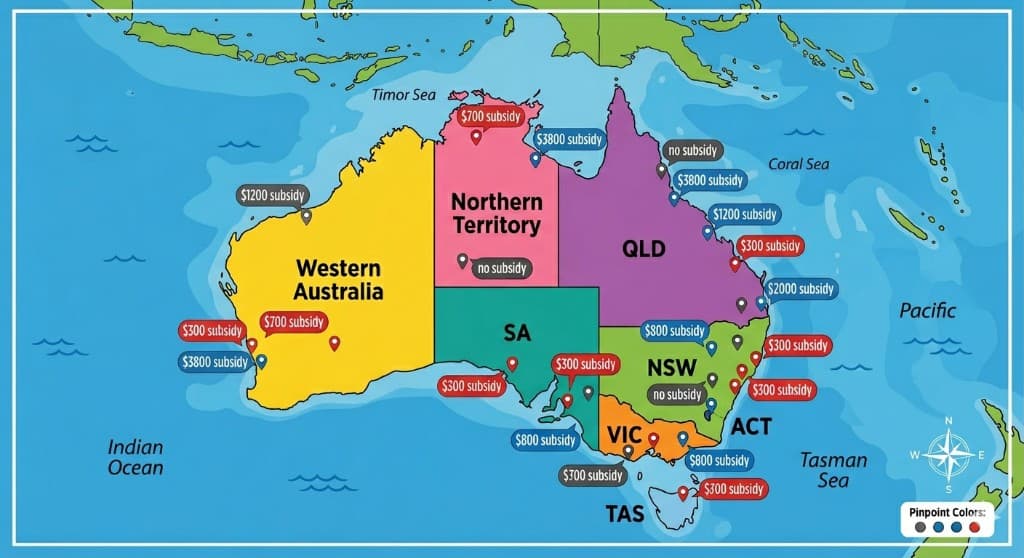
Eligible students in most states and territories can access government subsidies that significantly reduce the cost of the course. Subsidy schemes vary by state — Queensland's Career Start and Career Boost programs, NSW's Smart and Skilled, Victoria's Skills First, and equivalent programs in SA, WA, ACT, and Tasmania. Eligibility typically depends on your age, location, prior qualifications, and employment status. Use the eligibility checker or speak to a free Coursely advisor to confirm before committing to a provider.

Compare Certificate III in Individual Support by location

New South Wales:Sydney
Victoria:Melbourne
Queensland:BrisbaneGold Coast
South Australia:Adelaide
Western Australia:Perth
Tasmania:Hobart

Why Us

Why Use Coursely?

  • Privacy first

    No pesky spam — we never pass on your details without your consent

  • Coverage

    We are the most comprehensive, up-to-date course marketplace

  • Free to use

    No hidden fees or charges. Free and fast advice

What are people saying?

I'd been Googling care courses for weeks and getting nowhere. Coursely showed me the options side by side in minutes — I enrolled that afternoon.

Jess

Jess

Aged care student, NSW

I didn't realise there were subsidised options available in my state. The advisor saved me over $300 on the course I ended up doing.

Karen

Karen

Career changer, VIC

The course advisor was genuinely helpful and didn't try to push me toward anything. I felt like I was getting honest advice for once.

Tom

Tom

Disability support worker, QLD

FAQs

How fast can I actually complete the Certificate III in Individual Support?

The theory component can be completed in as little as 3 months with a fast track provider and consistent study. However, the mandatory 120 hours of work placement cannot be shortened — it is a fixed government requirement for all providers. Most students who choose a fast track course complete everything within 3 to 6 months, depending on how quickly they arrange and complete their placement.

What does the Certificate III and similar industry endorsed courses qualify you for?
These courses prepare you to work in roles such as aged care worker, disability support worker, or personal care assistant. It is the standard entry point into Australia care sector.
How do I compare courses effectively?

This is really up to you. Some students just want the cheapest course, the fastest. Some want a reputable brand, some want flexibility to study while they work.

The smartest way to decide is to complete the aged and disability care quiz and then speak to a course advisor for free — they'll walk you through your subsidy eligibility as well.

Alternatively use the Coursely comparison tool for quick options that suit you!

Are these courses accredited?

Two types of courses are listed on Coursely:

Certificate III Courses

Formal qualifications recognised within Australia's vocational education system. These are 'accredited' by Government, and eligible students can be entitled to Government subsidies.

Industry Credentials

Courses endorsed exclusively by industry bodies. These focus on practical skills and are typically faster and lower cost. Because they are not accredited by Government, students are not eligible for Government subsidies.

Both Certificate III and Industry Credentials can be used to legally work in Community Care (Ageing and Disability) in Australia — Australian Department of Health. See our full comparison guide.

What delivery formats are available?

Courses are delivered online, on-campus, or as blended learning. Many providers also offer workplace-based traineeships.

Certificate III courses require a mandatory work placement which will involve going into a real workplace for at least 120 hours. Some providers offer to organise this for you while others require you to organise this yourself. Worth checking before signing up. This is not a requirement with the industry endorsed course.

Am I eligible for government funding/subsidies?

Most states and territories offer funding schemes for Certificate III courses. Your eligibility will often depend on your location, age, prior qualifications, and employment status. See our subsidy eligibility guide, or contact a free course advisor through Coursely to check your eligibility and get matched.

Is there demand for this qualification?

Yes. With Australia's ageing population and growing NDIS sector, there is strong demand for qualified care workers in both aged care and disability support. Check out the YourCareer page for more helpful information.

Is this a full list of providers?

No. There are more than 400 providers offering the Certificate III in Individual Support, and many industry endorsed options.

We have listed as many as we can for you, noting the time and resources involved in keeping the information up to date. For a full list of Certificate III options you can go to training.gov.au or YourCareer, but these will not include information like pricing, duration or mode of study.

Guides & articles

View all

Feedback & Support

Coursely is currently in beta — we're working hard to make this the best course comparison experience in Australia. If you spot anything or have feedback, we'd love to hear from you. Share feedback →

Compare this course