Certificate III in Individual Support
TAFE Gippsland
$12,602
Full course price
$231
Subsidised price
VICStudy on campus or on the jobCampus: VIC (multiple locations)Next intake: Jul 2026Feb 2027Study for 8 - 11 months

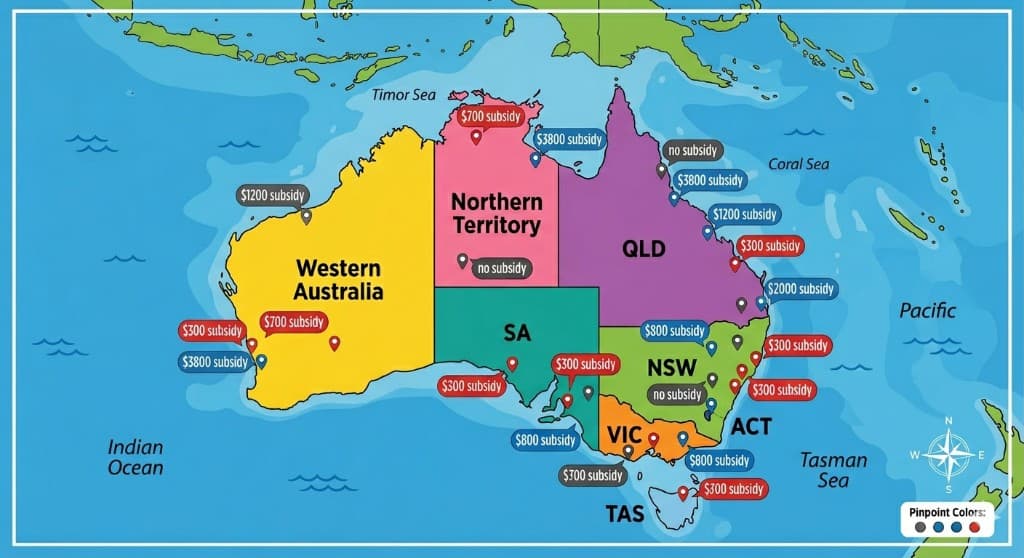
Many Australian states and territories offer government funding for the Certificate III in Individual Support. The schemes differ significantly — in name, eligibility rules, the size of the subsidy, and which providers can offer funded places.
This page breaks down what's available nationally so you can understand what you're likely entitled to before you choose a provider.
Step 1
Answer 5 quick questions
Tell us how you want to study, where you are, and what matters most to you. Takes under a minute.
Step 2
Compare matched courses
See your top matches side by side — real fees, delivery modes, and Government subsidies and special prices.
Step 3
Enrol with confidence
Before you commit, run a free pre-enrolment check — confirm if a subsidy may apply, your real out-of-pocket cost, and that you've found the right pathway. Takes minutes.
22 courses matched — showing 21–22, sorted by lowest price
Certificate III in Individual Support
TAFE Gippsland
Certificate III in Individual Support
Chisholm Institute
Government subsidies for vocational education in Australia are managed at the state and territory level, not federally. This means the amount you pay, the eligibility rules, and the providers that can offer funded places all vary depending on where you live. The qualification itself — CHC33021 — is the same everywhere; it's the funding arrangement that differs.
Subsidies work by the government paying a portion (or all) of your course fees directly to the RTO. You pay only the gap — sometimes nothing at all. The size of the subsidy depends on your state's funding rate for this qualification and your personal eligibility tier.
If you want to check eligibility in detail or reach your state or territory training authority directly, our VET subsidy and eligibility guide pulls together official links and pathways by jurisdiction — use it when you're ready to go straight to the source.
Queensland's Career Start and Career Boost programs subsidise training for eligible students. Subsidised fees can reduce the cost significantly, with some students paying as little as $0 depending on their circumstances and the provider.
NSW's Smart and Skilled program subsidises the Cert III for eligible students. The student contribution varies depending on your eligibility tier — concession rates apply for students receiving certain government payments. Funded places are allocated to approved providers and availability varies.
Victoria's Skills First program funds the Cert III for eligible students, with priority given to those who are unemployed, job seekers, or in lower-skilled employment. The subsidised fee varies by provider and eligibility category. Some students access the course at no cost under the Free TAFE initiative, though availability is limited.
SA offers subsidised training through Skills SA. Eligible students pay a reduced co-contribution fee. Concession rates are available for eligible recipients of certain government payments.
WA offers subsidised training for the Cert III through Future Skills WA for eligible students. Priority access is given to job seekers and those at risk of unemployment. Eligible students may access the qualification at low or no cost depending on their circumstances.
The ACT government subsidises the Cert III for eligible students through Skilled Capital. The student contribution varies by eligibility.
Skills Tasmania administers subsidised training for the Cert III for eligible individuals. The student contribution and available programs vary — contact a Coursely advisor or Skills Tasmania directly for current program details.
Even within a single state, your subsidised fee can vary based on:
State funding guidelines change periodically and provider availability of funded places fluctuates through the year. The most reliable way to find out what you may be entitled to is to speak to a free Coursely advisor — they can confirm which scheme applies in your state and whether you may meet the current eligibility criteria.
The Certificate III in Individual Support (CHC33021) is a government-accredited qualification for working in aged care, disability support, and home and community care in Australia. It sits at AQF Level 3 and is commonly held by aged care workers, disability support workers, and personal care assistants across both residential and community settings. Some people in these roles hold an industry credential instead — or alongside their Cert III — depending on their pathway into the sector.
The qualification is delivered by registered training organisations (RTOs) and typically takes between 6 and 12 months to complete, depending on the provider and delivery format. All students must complete a minimum of 120 hours of work placement with a real employer before graduating — this is a mandatory government requirement, not optional.
The Certificate III in Individual Support (CHC33021) is delivered as several streams. Your stream determines which core and elective units you complete. The official packaging rules and unit lists are published on training.gov.au — CHC33021 qualification details.
Time to complete: In practice, choosing one stream, a combined Ageing and Disability stream, or a generalist stream usually fits the same overall timeframe (for example the common 6–12 month range) — providers timetable different electives, but the qualification is still the same AQF level and total nominal hours are comparable. Confirm exact duration with your RTO.
Does a broader certificate make you more “competitive”? Adding streams or electives does not automatically give you deeper or richer learning than the standard pathway — you still cover the same essential skills for entry-level roles, and employers typically care at least as much about placement, reliability, and fit. Where it can help is how your qualification reads on paper (for example the stream named on your testamur), which some students and hiring managers notice; it is not a substitute for experience on the job.
Providers describe delivery in different ways. For a fuller breakdown — including how "online" can feel day to day — see our guide on online vs on-campus Certificate III in Individual Support.
Eligible students in most states and territories can access government subsidies that significantly reduce the cost of the course. Subsidy schemes vary by state — Queensland's Career Start and Career Boost programs, NSW's Smart and Skilled, Victoria's Skills First, and equivalent programs in SA, WA, ACT, and Tasmania. Eligibility typically depends on your age, location, prior qualifications, and employment status. Use the eligibility checker or speak to a free Coursely advisor to confirm before committing to a provider.
Why Us
No pesky spam — we never pass on your details without your consent
We are the most comprehensive, up-to-date course marketplace
No hidden fees or charges. Free and fast advice
“I'd been Googling care courses for weeks and getting nowhere. Coursely showed me the options side by side in minutes — I enrolled that afternoon.”

Jess
Aged care student, NSW
“I didn't realise there were subsidised options available in my state. The advisor saved me over $300 on the course I ended up doing.”

Karen
Career changer, VIC
“The course advisor was genuinely helpful and didn't try to push me toward anything. I felt like I was getting honest advice for once.”

Tom
Disability support worker, QLD
This is really up to you. Some students just want the cheapest course, the fastest. Some want a reputable brand, some want flexibility to study while they work.
The smartest way to decide is to complete the aged and disability care quiz and then speak to a course advisor for free — they'll walk you through your subsidy eligibility as well.
Alternatively use the Coursely comparison tool for quick options that suit you!
Two types of courses are listed on Coursely:
Certificate III in Individual Support (CHC33021)
All providers of this Certificate are accredited with the Australian Skills Quality Authority (ASQA). The RTO code for all providers can be found on training.gov.au.
Industry Credentials
Courses endorsed exclusively by industry bodies. These focus on practical skills and are typically faster and lower cost. Because they are not accredited by Government, students are not eligible for Government subsidies.
Both Certificate III and Industry Credentials can be used to legally work in Community Care (Ageing and Disability) in Australia — Australian Department of Health. See our full comparison guide.
Courses are delivered online, on-campus, or as blended learning. Many providers also offer workplace-based traineeships.
Certificate III courses require a mandatory work placement which will involve going into a real workplace for at least 120 hours. Some providers offer to organise this for you while others require you to organise this yourself. Worth checking before signing up. This is not a requirement with the industry endorsed course.
Many states and territories in Australia offer government subsidies for the Certificate III in Individual Support, but the schemes, eligibility rules, and subsidy amounts differ by location. Eligibility typically depends on your state of residence, prior qualification history — some schemes exclude those who already hold a Certificate IV or higher — and current study status. It is not means-tested. Funded places at individual providers are limited and vary through the year. Use our subsidy guide or speak to a free Coursely advisor to find out whether you may qualify before choosing a provider.
Yes. With Australia's ageing population and growing NDIS sector, there is strong demand for qualified care workers in both aged care and disability support. Check out the YourCareer page for more helpful information.
No. There are more than 400 providers offering the Certificate III in Individual Support, and many industry endorsed options.
We have listed as many as we can for you, noting the time and resources involved in keeping the information up to date. For a full list of Certificate III options you can go to training.gov.au or YourCareer, but these will not include information like pricing, duration or mode of study.
NDIS Worker Screening Check — What Support Workers Need to Know

Accredited vs Industry Credential: Which Care Course Pathway Fits You?

Certificate III in Individual Support: What Career Changers Actually Need to Know

Certificate III in Individual Support: A Straight-Talking Guide for Existing Support Workers

How Long Does Certificate III in Individual Support Take?

Online vs On-Campus Certificate III in Individual Support: What Actually Changes (and What Doesn't)

Work Placement in Certificate III Individual Support: What the 120 Hours Means and How to Plan It

Cheapest Certificate III in Individual Support Courses in Australia

Certificate III in Individual Support Cost Guide (Australia 2026): Real Prices, Subsidies and What to Check Before You Enrol

Aged & Disability Care Pay Guide (Australia 2026)

How to Become an Aged or Disability Care Worker in 2026

Picking the Right VET Provider: Complete Checklist 2026
VET Government Subsidy Calculator (NSW/QLD/VIC/WA/SA/ACT/TAS) 2026
Coursely is currently in beta — we're working hard to make this the best course comparison experience in Australia. If you spot anything or have feedback, we'd love to hear from you. Share feedback →